














Dyslexia
WELCOME TO THE ALL 4 KIDS UK CHILDHOOD DEAFNESS RESOURCE PAGE. BELOW YOU'LL FIND HELPFUL ADVICE KINDLY SUPPLIED BY ASSESS EDUCATION. SEE HERE FOR ORGANISATIONS, TUTORS AND SCHOOLS THAT CAN HELP.
What is Dyslexia?
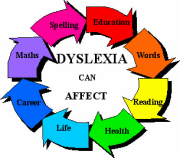
Approx 10% of the population has some degree of dyslexia. Dyslexia is not a disease and cannot be 'cured'. Strategies can be used to overcome most of the difficulties and many individuals have their dyslexic profiles to thank for their enhanced skills in certain areas. The manifestations of dyslexia are persistent problems with some, or all, of the following: reading, spelling, writing and maths. Dyslexics usually develop their own strategies for coping, but early diagnosis and specialist support is beneficial, both educationally and psychologically.
Dyslexia is often called a specific learning difficulty. Case histories are useful before assessment to ascertain any difficulties before, during and after birth (where birth trauma may have given rise to an acquired dyslexia) or the incidence of written language difficulties within the family (evidence of developmental dyslexia). In the case of an acquired dyslexia, it would not have been present unless the brain had been damaged by illness or accident. Often, in such cases, there is a considerable disparity (in levels of ability) between the two hemispheres.
Developmental dyslexics tend to have a poor short-term (working) memory in common. Due to the resulting difficulties, sequencing is often an area of weakness and therefore, apart from the more obvious problems, most dyslexics are poorly organised. A diagnosis of specific developmental dyslexia is given when an individual is of average (or above) intelligence and where their test results show a particular pattern (of strengths and weaknesses). Dyslexia is often referred to as a syndrome, because of the various signs and symptoms (there is not one single feature) associated with it. It occurs in every ability range, but is more easily detected when it is not part of a general difficulty, due to lack of intelligence.
Indicators of Dyslexia
(given an average or above ability level)
Pre-school:
- Family history
- Late and/or unclear speech
- Inability to remember the label for known objects e.g. colours
- Confused directional words, e.g. 'up/down' or 'in/out'
- Enhanced creativity - often good at drawing - good sense of colour
- Aptitude for constructional or technical toys, e.g. bricks, puzzles, Lego blocks, control box for TV and video, computer keyboards
- Difficulty learning nursery rhymes
- Finds difficulty with rhyming words, e.g. 'cat mat fat'
- Difficulty with sequencing
- Appears bright, but...
For children of 9 or under:
- Particular difficulty with reading and/or spelling and writing
- Persistent and continued reversing of numbers and letters (e.g.'15' for '51', 'b' for 'd')
- Difficulty telling left from right
- Difficulty learning the alphabet and multiplication tables, and remembering sequences such as the days of the week and months of the year
- Poor concentration
- Signs of frustration
For children of 9-12:
- Continued mistakes in reading and poor comprehension of text
- Strange spelling, perhaps with letters missed out or in the wrong order
- Taking an above average time over written work
- Poor organisation at home and at school
- Difficulty copying accurately from blackboard or textbook
- Difficulty taking down oral instructions
- Growing lack of self-confidence and increasing frustration
For pupils of 12-18:
- Tendency to read inaccurately, or without comprehension
- Inconsistent spelling
- Difficulty with planing and written essays
- Tendency to confuse verbal instructions and telephone numbers
- Difficulty with learning a foreign language
- Low self-esteem
- Difficulty with perception of language, e.g. following instructions, listening comprehension
Adults:
Adults may present with any of the indicators in the preceding category. The most common residual problem in adults is a poor short-term memory.
A typical assessment will include:
Case History I
This is taken (usually by means of a questionnaire) prior to the assessment.
Case History II
We use both verbal and non-verbal testing procedures. No reading skills are necessary and there is no written language involved.
Reading Test
The client is asked to read a list of words which become more difficult as the test progresses
Spelling Test
The client is asked to write down spellings which are read out by the tester. After five consecutive incorrect spellings the test is concluded.
Freewriting
The client is asked to write on a subject of their choice without worrying too much about the spelling. The object here is to see the kind of difficulties the client is experiencing when setting their thoughts on paper.
Dyslexia Test
The test used most commonly is the Bangor Dyslexia Test. Dyslexia positive indicators are sought through a series of sub-tests. It is essential that this test is not administered in isolation. There may be other reasons for scoring 'positive' on sub - tests and therefore the 'Bangor' should only be used in conjunction with a test of ability.
Early Diagnosis
We use a variety of testing procedures for 4½ to 8 year olds including the CoPS (Cognitive Profiling System) which consists of a series of computer 'games'. The results indicate 'at risk' development in visual / perceptual or auditory / verbal functioning. CoPS is not always suitable and sometimes other tests are used instead.
A Debrief
At the end of the assessment we explain exactly what we have found and make recommendations with regard to strategies for dealing with presenting difficulties. This is delivered in easy to understand, jargon-free language. The verbal debrief is followed up by a written report to your home address approximately ten working days after the assessment.
